Built by translators,
for translators.
We've spent years managing manga localization with spreadsheets, shared drives, and duct-taped workflows. Zfuro is the platform we wished existed.
The problem
Professional manga localization involves dozens of people (translators, proofreaders, editors, typesetters, QA reviewers, delivery managers) often spread across time zones and working as freelancers for multiple clients simultaneously.
Most teams manage this with a patchwork of Google Drive, Slack, spreadsheets, and email. Source files get lost. Versions multiply. Freelancers can't see what they need. Managers can't see what's done. Publishers worry about leaks. Nobody has a single view of the pipeline.
General project management tools do not understand manga, so scheduling in them is manual guesswork: a Gantt chart has no idea a translator and a letterer work at different speeds, or that proofreading cannot start until translation is done. AI-only tools skip the human translation step that publishers actually require. There was no production platform purpose-built for the way manga localization teams actually work.
What we built
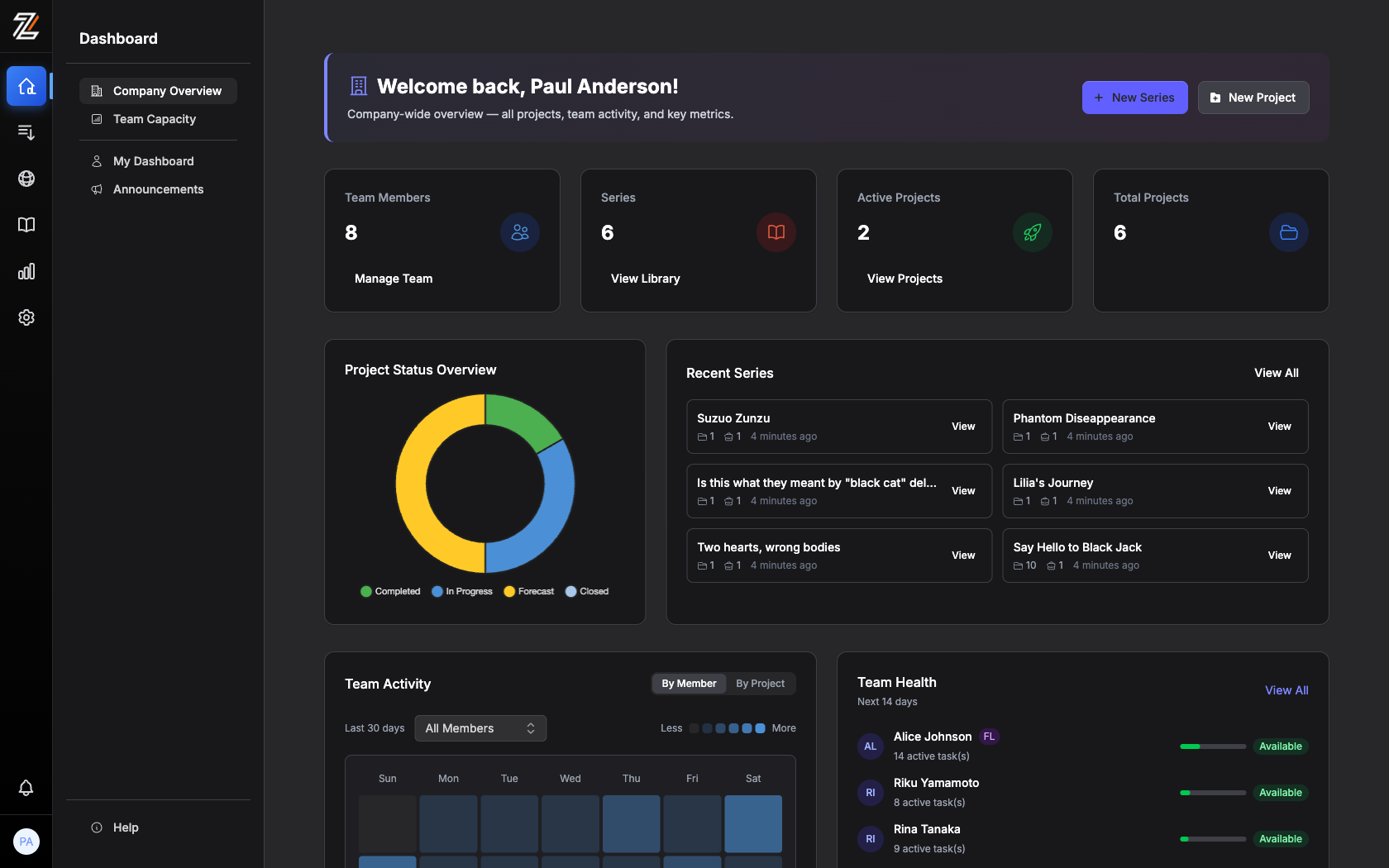
Zfuro is the production OS for manga localization. One platform where the entire pipeline lives, from project planning to final chapter delivery.
We designed it to be modular. Studios can plan and schedule an entire production, computing realistic deadlines from each worker's real capacity and gating every stage, before uploading a single file. When they are ready, they add asset management and full production workflows. That order also respects a practical truth: many studios will not upload client assets to a new platform on day one, and trust takes time.
Read our guide on planning a manga localization pipeline.
We built it around the realities of the industry: freelancers are the backbone of production (so they're always free and unlimited), IP protection is non-negotiable (so every preview is watermarked per user), and the workflow isn't linear (so our engine handles parallel tasks, role-based handoffs, and real-time collaboration out of the box).
AI handles the grunt work (OCR text extraction and first-pass drafts), but human translators drive the quality. We're not replacing anyone. We're giving them better tools.
How we think
Freelancers are the network
Your network is a competitive advantage, and we'll never charge you for growing it. Unlimited users on every plan.
IP is sacred
Per-user watermarks, signed temporary URLs, role-scoped file access, full audit trails.
AI assists, humans decide
AI extracts text and generates first drafts. Human translators refine, proofread, and ensure the quality that publishers demand.
Your roster is your edge
A freelancer pool with engagement history and internal ratings and notes. Remember who did great work and book them again.
The team
We're a small team with over 20 years of combined experience in manga translation, language services, and software engineering. We've worked as translators, managed localization teams, and built production systems for publishing companies.
Zfuro is based in the EU and serves localization teams worldwide.
Working with us
We're a small, founder-led team, and we like it that way. As a founding studio you get direct access to the people building Zfuro and a real say in what we build next. When you write to us, you reach someone who works on the product, not a queue.
Our mission
To give manga localization teams a single platform that replaces fragmented toolchains, so they can focus on the craft of translation instead of the logistics of production.
Our vision
To become the default production infrastructure for every professional manga localization team, the way Figma became default for design teams or GitHub for engineering teams.
Want to see what we've built?
Start on the Free plan, or talk to us about your production workflow.